
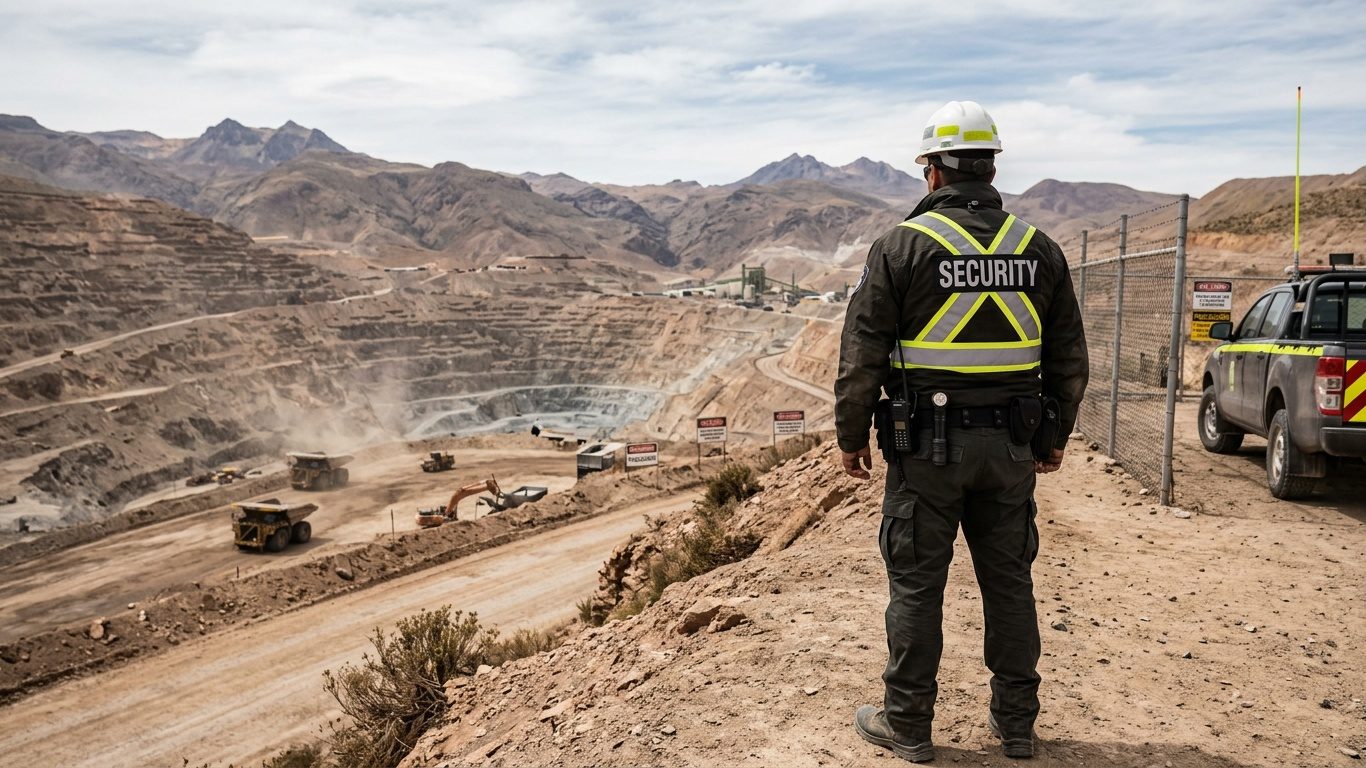

As demand for critical minerals accelerates, securing supply chains requires more than protecting mines and infrastructure. In this article, Chris Galvin, ICoCA’s Head of Public Affairs and Business Development, examines how private security practices shape relationships with local communities, influence operational continuity and can either undermine or strengthen supply chain resilience. He argues that responsible security must move from the margins to the centre of the critical minerals agenda, supported by stronger procurement, accountability and industry standards.
I. Why responsible security needs to move from the margins to the centre of the critical minerals and mining agenda
The need to secure critical mineral supply chains has never been higher on the political and policy agenda. Governments are worried about supply-chain resilience, companies are competing for access to strategically important minerals such as copper, lithium, cobalt, nickel, graphite and rare earths, and investors are assessing financial risks, from geology to geopolitics. As the critical minerals rush gathers pace with deposits being discovered and new projects under development in increasingly complex operating environments, a fundamental question is still too rarely asked.
II. Who secures these supply chains and how?
Securing a critical mineral supply chain requires more than protecting a mine. It means creating a security ecosystem that extends throughout the entire lifecycle of a project. From exploration and construction to extraction, processing, refining, transport and storage, all the way through to project closure. It means looking beyond individual sites to the roads, railways, pipelines and power infrastructure, refineries, warehouses, border crossings, ports and logistics networks that connect production to international markets. As Gracelin Baskeran recently testified before the before the House Ways and Means Committee, “competing in these markets requires building the ecosystem around the mine, not simply the mine itself. A company can develop an orebody; it cannot independently build the rail, ports, power, and customs systems that make production bankable.”
From the first interactions with communities living around a potential mining site to the movement of minerals across borders, security arrangements intersect with people and communities at every stage. The resilience of critical mineral supply chains therefore depends not only on securing resources, infrastructure and trade routes, but also on managing the relationships between mining companies, refineries, security providers, governments, transport operators, storage facilities, ports, energy providers and the communities through which those supply chains run.
III. What’s missing from the critical minerals agenda?
Security is everywhere but it’s often treated as an outsourced service, a cost centre to keep down, rather than an integral function of a business. Responsible security practices are largely missing from the most important conversations of involved industries. Look at any of the major mining conferences over the last few years and you’ll rarely see security as a topic on its own being addressed, let alone responsible security. Debates around community engagement including free, prior and informed consent, trust-building and the social license to operate are becoming more visible, however, these are not being connected to the intrinsic role security plays in winning or losing community acceptance around a mine site and beyond. This is a significant omission. Security arrangements can influence whether communities experience a mining project as a responsible neighbour or as a source of intimidation, exclusion and conflict.
The Voluntary Principles on Security and Human Rights, which guides extractive companies in conducting comprehensive human rights risk assessments related to security operations, have been in existence for more than 25 years. The International Code of Conduct for Private Security Service Providers, which sets out principles for security companies in line with human rights and international humanitarian law, has passed its 15-year anniversary. Yet, neither of these frameworks are provided a regular platform on the mining industry’s annual global events calendar.
IV. Why do responsible security practices matter?
At their best, responsible security practices are embedded in community engagement from exploration stage onwards, throughout the lifecycle of a mining project. When security personnel are recruited from local communities into good private security jobs, they can act as social sensors, relaying information back and forth between community and company, and vice versa. ICoCA is documenting cases where this approach has become central to a client’s community engagement strategy. When issues from the community arise, they are addressed immediately, not left to fester and turn into grievances that may threaten the viability of a project or leave an expensive legacy throughout a project’s lifetime. When security personnel are offered meaningful careers, well trained and well-treated, and when security is integrated as a core business function in the extraction and marketing of minerals, the results can be transformational. The case of Geita Gold Mine in Tanzania demonstrates that this approach can work even for such a high-value ore. When a mine closes, a company’s approach to security throughout the various phases of closure can have implications beyond one mine, as its legacy and the experiences of affected communities may influence whether licenses for other mines are granted.
A security guard, whether at a mine entrance, a checkpoint or a warehouse, is often the first representative of the company that a community member encounters. A security patrol may determine whether people feel welcome or threatened. The way security personnel respond to a protest, a land dispute or an attempt to enter a site can influence whether a disagreement is resolved peacefully or escalates. These interactions extend well beyond the mine gate. Along transport corridors, security personnel may encounter local residents, artisanal miners, protesters or other groups. When trusted, communities will raise concerns to security personnel about speeding trucks, traffic congestion and the effects of mining-related activities on their daily lives. Security personnel can then relay their concerns to the appropriate parties. At a port, private security may be responsible for access control and protection of stockpiles and cargo. Security personnel are on the frontline of community engagement, 24/7, 7 days a week and represent the client in the eyes of local communities. Their behaviour and actions can have a profound impact on a project’s success, influencing the community’s perception of the company itself. When security is professional, proportionate, respectful and properly supervised, it can help create an environment in which tensions are managed rather than inflamed.
The resilience of critical mineral supply chains, therefore, depends not only on securing resources, infrastructure and trade routes, but also on building trustful relationships between the security companies contracted to guard assets and transportation corridors and the communities around them. Responsible security practices are essential to building and maintaining these relationships. It is one of the ways in which companies put their commitments to human rights, respectful engagement and responsible business conduct into practice.
V. How can security practices drive conflict and threaten supply chains?
Community relations can be badly damaged by irresponsible security practices. Too often, security personnel are poorly paid and poorly treated, used and abused through excessively long working hours. Pushed into poverty but placed in positions of power, security personnel can be lured into collusion and corruption to make ends meet. A growing number of studies based on country surveys conducted by ICoCA illustrate the connection between poor working conditions and criminal activity. A recently released paper by the UN Office on Drugs and Crime, “Minerals Crime: How Organized Groups Exploit Vulnerabilities in Critical Energy Transition Mineral Supply Chains in Southern Africa”, reports that “[…] private security personnel, often hired by syndicates or complicit operators, are armed with semi-automatic rifles to control workers, repel competitors, and enforce silence; an allegation reinforced by a private investigator who reported that armed guards attached to logistics corridors and port warehouses ensure valuable consignments move without interference.”
A confrontation involving security personnel can quickly call into question the legitimacy of the entire operation of a project. While security is contracted to mitigate operational risk, security contractors themselves can be a source of insecurity. Corruption, theft, collusion with criminal networks, excessive use of force and intimidation can undermine supply chain integrity, fuel community grievances, trigger protests and disrupt operations.
When security is perceived as threatening, arbitrary or abusive, the consequences can extend far beyond individual incidents, undermining a company’s social license to operate, corroding its reputation and threatening the viability of a project. The resulting costs affect a company’s bottom line as well as businesses and stakeholders further downstream in the supply chain. A recent Wharton study calculates the financial consequences of 28 Indigenous rights-related conflicts for mining firms in Peru between 1996 and 2025 at USD 31.9 billion.[1] Across interconnected supply chains, the effects can extend far beyond the site where an incident occurs. Disruption at a mine, along a transport corridor or at a port can undermine confidence in the wider operation and expose vulnerabilities in the movement of minerals from production to market.
VI. Why has this conversation been missing? An inconvenient truth
Security is politically sensitive. Mining companies and companies operating other critical national infrastructure often operate in countries where public security forces play an important role alongside private security providers. Discussions about security can therefore touch on policing, sovereignty, government authority, public order and political sensitivities. It is understandable that companies may hesitate to ask difficult questions about how security is provided.
But political sensitivity is not a reason to leave security governance unexamined. Indeed, where security carry significant human rights and operational risks, good governance becomes even more important.
And then there is the question of cost. Responsible security requires investment, starting with better recruitment and vetting, appropriate training, fair pay and decent working hours, effective supervision, human rights due diligence, community engagement, incident reporting, grievance mechanisms and independent oversight. These measures can add up to significant costs. And they are very much visible.
The benefits, however, are often not. A well-trained security officer who de-escalates a confrontation does not generate a line-item showing the avoided cost of the crisis that never happened. A mine that continues operating because a dispute was resolved before it escalated does not produce a headline. A community that trusts the company’s security arrangements does not appear on a balance sheet. And a security guard who refuses to collude and facilitate diversion through petty theft, internal corruption or collusion with criminal syndicates is rarely recognised for their integrity.
Yet these are precisely the kinds of outcomes that can underpin a project’s social licence to operate, providing operational continuity and supply chain resilience. A single serious incident can result in community outrage, operations shutdown and lead to reputational damage that can impact a project and its financial liability for years after.
VII. Whose business is security, anyway?
If responsible security is to move onto the critical minerals agenda, it cannot remain the responsibility of the Chief Security Officer alone. Many sustainability and human rights teams at some of the largest mining companies increasingly understand the security environment around their assets and collaborate closely with their security counterparts. Some even wear the same hats. Community relations teams often do understand how security arrangements affect local perceptions and grievances. Yet procurement teams, reporting to the finance departments, may not be fully aware of the financial risks they run when human rights performance is not sufficiently factored into the selection and contracting of private security providers. Risk teams should consider security-related human rights incidents as potential business continuity risks, while boards should be asking how security arrangements relate to material human rights and operational risks. Security teams themselves need to be part of all these conversations from the outset – not brought in to manage a crisis after something has gone wrong.
This means changing how companies select, contract and oversee security providers. In a competitive market, procurement processes can place considerable emphasis on price. Yet the cheapest provider, usually procurement’s teams preferred option, is not necessarily the most cost-effective choice. Poor training, inadequate supervision, weak incident management or abusive practices can increase the likelihood of conflict, disruption and reputational damage. The costs of these failures can far exceed the additional investment in a responsible provider. Responsible procurement can therefore be a practical mechanism for changing the market. ICoCA’s procurement assessment is one tool that can assist companies make more informed decision about security providers. Contracting an ICoCA member or affiliate company provides an additional level of assurance through ICoCA’s ongoing monitoring and verification. Contracting an ICoCA certified company represents the highest level of assurance available in the marketplace.
Mining companies, transportation and logistics providers alike should be asking security companies about their recruitment and vetting, training, human rights policies, incident management, use of force, community engagement and oversight. Appropriate requirements should be built into tenders and contracts. ICoCA’s procurement guide provides the handrails for companies to follow.
VIII. What needs to change?
First, embed responsible security within the mainstream critical minerals supply chain conversation.
Security is central to supply chains resilience and must be firmly on the policy agenda. Responsible security should be tackled head on at mining, commodity trading and logistics conferences, alongside human rights, indigenous rights, community engagement, responsible sourcing and social performance, not considered marginal simply because it is outsourced. The conversation must also extend beyond the mine gate to encompass transport corridors, logistics infrastructure, storage facilities and ports.
Second, promote responsible procurement.
Mining companies, logistics and transportation companies, refiners, ports and shippers all have considerable influence over the security providers they employ. By incorporating human rights expectations and appropriate assurance requirements into procurement, they can create stronger incentives for responsible business practices. This means moving beyond price-led contracting to consider the quality of recruitment, working conditions, training, supervision, incident reporting and accountability. It also means monitoring performance throughout the contract and addressing shortcomings when they arise. Industry associations, investors, governments and civil society can reinforce this shift by making responsible security a visible part of the definition of responsible mining.
Third, raise industry standards to raise security standards.
A number of relevant standards are currently being revised, including the Initiative for Responsible Mining Assurance (IRMA), the Critical Minerals Security Initiative (CSMI) and the IFC Performance Standards. ICoCA has submitted suggested revisions to all three, advocating that mining companies and other actors across the critical minerals value chain require their private security providers to hold ICoCA membership or affiliation. ICoCA is the global standard for the private security industry. This shouldn’t be a nice to have. The forthcoming revisions to the IFC Performance Standards will help shape due diligence expectations for large infrastructure projects supporting critical mineral supply chains for decades to come. Investors, including development finance institutions that apply the IFC Performance Standards, have leverage to influence responsible security practices across these supply chains. By helping companies build trust with local communities and secure their social licence to operate, investors can also help strengthen supply chain resilience.
It’s time to bake responsible security practices that respect human rights into the energy transition agenda and to leverage ICoCA as the established, tested private security industry standard to achieve this.
Sources
[1] The Costs of Conflict: Financial consequences of Indigenous rights-related conflicts for mining firms in Peru, 2026, Doron Tadmor, Witold Henisz